Ⅰ. What is Employment24 ?
A 24/7 online employment center and integrated digital platform that unifies previously fragmented online service channels and administrative functions into one system.
1. Background
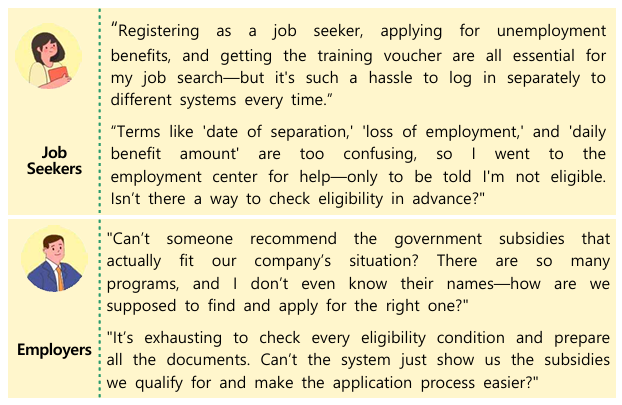
The Ministry of Employment and Labor has been operating a variety of online employment services, including job placement (WorkNet), unemployment benefits and employment incentives (Employment Insurance), and vocational training (HRD-Net). As a result, users had to navigate multiple platforms to access employment services, often dealing with inconvenient and complex procedures that mirrored traditional paper-based forms. In contrast, countries like France and Germany are shifting toward digital employment services that go beyond simply providing job information, using big data and AI to deliver personalized job and training recommendations. France’s public employment agency, Pôle Emploi, began a major digital transformation in 2012 and invested €455 million (approximately KRW 541 billion) over three years starting in 2018. Following this global trend, Korea launched Employment24—a next-generation digital employment platform that integrates systems like WorkNet and leverages technologies such as AI to provide tailored services.
2. Progress to Date
ISP(Information Strategy Planning) in 2021 → Service Provider Selected in September 2022 → Development of Employment24 Began in October 2022 Phased rollout of key services began in November 2023 → Pilot operation launched in March 2024 In September 2024, all online employment services* were consolidated into Employment24 → Official launch completed.
* Including WorkNet, Employment Insurance, HRD-Net, Foreign Workforce Management, and the National Employment Support Program.
3. Key Features: “Personalized Employment Services, Made Easy with Employment24”
①Integration of Online Administrative Services
By consolidating nine separate online employment services into a single platform, users can now apply for, report, and track services in one place—greatly improving accessibility for the public. ➊ WorkNet, ➋ Employment Insurance, ➌ HRD-Net, ➍ National Employment Support Program, ➎ EPS (Employment Permit System for Foreign Workers), ➏ Youth Jobs, ➐ Youth Tomorrow Savings Program, ➑ SME Youth Job Experience Program, ➒ Youth Challenge Support Program Through information integration, the system reduces the need for supporting documents and data entry by eliminating requirements for information already held by the government.
②Enhanced Personalized Recommendation Services
Based on the specific characteristics of individuals and companies, Employment24 offers tailored guidance on likely eligible subsidies, recommends jobs, training, and certifications aligned with job seekers’ skills, and enables businesses to search for and apply for employment support programs directly through their internal ERP systems—without needing to visit Employment24—by linking with private ERP platforms.
③Efficient Service Processing Using Automated Screening and Robotic Process Automation (RPA)
By automating repetitive tasks such as subsidy evaluations, mailings, and payment processing, staff efficiency is improved and more time is made available for personalized counseling.
●Key Features and Functions of Employment24
1) Induviduals ‧ Businesses
By integrating multiple sites, users can access a wide range of employment services and support with a single login. Individuals can access services such as job placement support, government subsidies, training vouchers (The National Tomorrow Learning Card), unemployment benefits, etc. Businesses can utilize talent recruitment, government subsidies, training programs, and foreign workforce management services, etc.
Through personalized recommendation features, users receive tailored information based on their membership profile without needing to search separately. The JobCare function offers competency assessments based on desired occupations and recommends relevant jobs, training, and certifications. The service recommendation feature suggests employment services and subsidies suited to the characteristics of individuals and businesses. Additionally, the labor market information feature provides data such as actual wages by occupation and wage gaps between what employers offer and what workers expect.
By streamlining application procedures through data integration, Employment24 reduces input fields, enables pre-screening of eligibility, and minimizes documentation requirements—making the application process simpler and more user-friendly.
The Policy Guide feature clearly introduces various support programs tailored to individuals (by stages of employment) and businesses (by stages of HR management).
2) Businesses
By offering integration with private ERP systems, Employment24 enables businesses to search for and directly apply for employment subsidies and other support programs within their own ERP platforms.
3) Internal PES Staff
The automated subsidy screening feature allows the system to determine eligibility without the need for separate document verification. Through task automation, Employment24 enables automatic online mailing of documents that were previously sent manually and links received e-faxes (such as applications and attachments) directly to the system. The firm banking feature streamlines general accounting payment processes, making financial transactions more efficient. The pilot consultation auto-recording feature uses Speech-to-Text (STT) technology to summarize and document counseling sessions.
4. Employment24 Public Portal Interface Overview
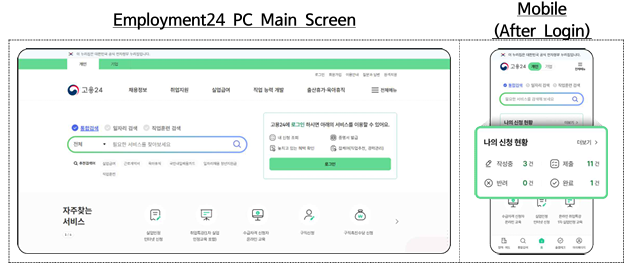
●(PC) Access via computer or laptop browser at www.work24.go.kr
●(Mobile) Accessible on mobile devices such as smartphones and tablets, with a redesigned user interface optimized for smaller screens (m.work24.go.kr). * The smartphone app offers additional features such as push notifications and location-based services.
Ⅱ. Employment24 Operational Achievements
1. Employment24 Usage Overview
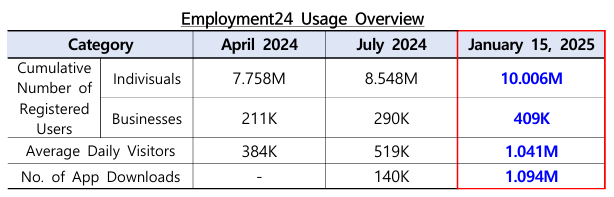
The number of registered users, average daily visitors, and app downloads have all continued to rise. As of January 15, 2025, Employment24 had 10.006 million individual members, 409,000 registered companies, and an average of 1.041 million daily visitors.
2. Service Improvement Outcomes
●Individuals
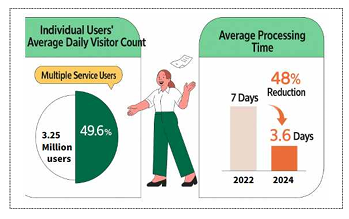
①As of 2024, among the 3.52 million users who submitted civil service applications, 49.6% (1.76 million users) utilized Employment24 as a single integrated platform, rather than visiting separate websites to apply individually. Among users who accessed two types of services, the most common combinations were job application and unemployment benefits (266,000 users), job application and National Employment Support Program (425,000 users). For those who used three types of services, the most frequent combination was job application, unemployment benefits and issuance of the National Tomorrow Learning Card (6,000 users).
②The average processing time for civil service applications* was reduced from 7 days in 2022 to 3.6 days in 2024 — a decrease of approximately 48%.
* civil service applications: e.g., unemployment benefits, National Tomorrow Learning Card, National Employment Support Program, etc.
Voices from the Field (Individual Users) “As someone applying for employment services for the first time, it was all very confusing at first. But now, instead of jumping from site to site like before, I can manage everything on a single page. It’s incredibly convenient and reassuring!” |
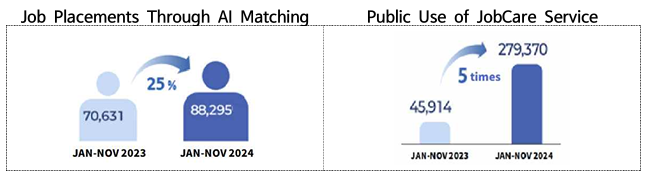
③With the expansion of AI-powered job matching and Job Care services, the number of users successfully placed in jobs through AI recommendations has increased by 25.0%, while the use of the Job Care service has grown fivefold.
●Businesses
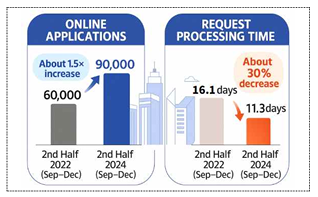
①With the addition of pre-screening and simulation functions, the number of online applications for corporate subsidies (three types)* increased from 60,000 in the second half of 2022 to 90,000 in the second half of 2024—a 1.5-fold increase.
* Maternity and Parental Employment Stability Subsidy, Work-Life Balance Job Subsidy, Elderly Employment Support Subsidy
②The average processing time for complex employment subsidies* with detailed eligibility requirements was reduced by approximately 30%, from 16.1 days in 2022 to 11.3 days in 2024.
* Employer Subsidy: Employment Promotion Subsidy, Continued Employment Incentive for Older Workers, Employment Retention Subsidy (two types)
Voices from the Field(Employer representatives) “It’s really convenient that all employment services are integrated in one place, making them easy to check. I also tried applying for subsidies myself, and I was impressed by how smoothly everything worked thanks to the well-connected information system—it made the whole process much easier.” |
Appendix. Key Features of Employment24 for Business and Individual Users
■ Individual Users
As of the end of December 2024, Employment24 had a total of 9.84 million individual users, with women accounting for 54.7% and users in their 30s or younger making up 49.6%. From January to October 2024, there were 7.37 million employment service transactions, with 36.3% of registered users benefiting from at least one service. Younger users primarily accessed career exploration services, while middle-aged and older users focused on services that support reemployment and skills enhancement.
①Resigtration Overview
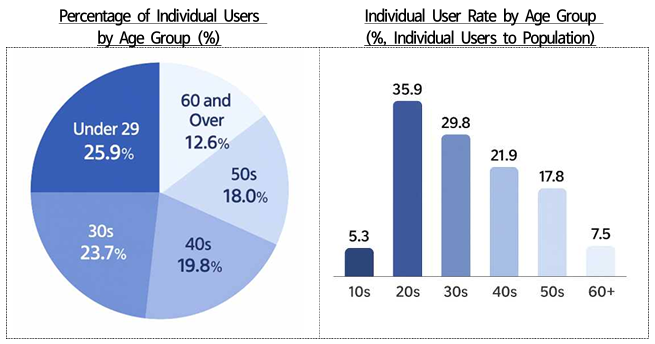
As of the end of December 2024, Employment24 had 9.84 million individual members, accounting for 18.8% of the population aged 15 and over. In terms of gender, a greater proportion of members were female (54.7%) than male (45.3%). By age group, individuals aged 29 and under (25.9%) and those in their 30s (23.7%) accounted for nearly half of all members, followed by those in their 40s (19.8%), 50s (18.0%), and 60 and older (12.6%). When comparing membership rates relative to the population by age, the highest rates were observed among people in their 20s (35.9%), followed by those in their 30s (29.8%), 40s (21.9%), and 50s (17.8%), with the 60+ age group showing a relatively lower rate of 7.5%.
②Main Services Used
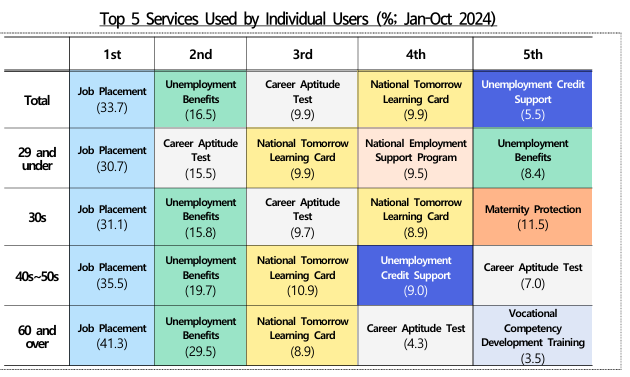
Among the 9.84 million individual users, 3.57 million (36.3%) used one or more of the 158 employment services between January and October 2024, totaling 7.37 million service uses. The most frequently used service was job placement (employment search), accounting for 2.48 million cases (33.7%), followed by unemployment benefits (1.22 million cases, 16.5%), career aptitude tests (730,000 cases, 9.9%), National Tomorrow Learning Card services (730,000 cases, 9.9%), unemployment credit support (410,000 cases, 5.5%), National Employment Support Program (360,000 cases, 4.9%), vocational competency development training (280,000 cases, 3.8%), and maternity protection services (250,000 cases, 3.4%). By age group, the largest share of employment service users were those aged 29 and under (30.6%), followed by users in their 30s (22.6%), 40s (17.4%), 50s (16.4%), and 60 and older (13.1%). Across all age groups, job placement (employment search) was the most commonly used service.
Among users aged 29 and under, there was high usage of career-related services such as career aptitude tests (15.5%), the National Tomorrow Learning Card (9.9%), and the National Employment Support Program (9.5%). Users in their 30s showed higher usage of maternity protection services (11.5%), such as parental leave benefits, compared to the average of 3.4% across other age groups. Users in their 40s and 50s frequently used services aimed at strengthening reemployment capabilities, such as unemployment benefits (19.7%), unemployment credit support (9.0%), the Tomorrow Learning Card (10.9%), and vocational competency development training (4.8%). For users aged 60 and older, unemployment benefits accounted for 29.5% of service use—significantly higher than the overall average of 16.5%.
■Business Users
As of the end of December 2024, there were 400,000 registered business members, accounting for 21.7% of all workplaces. A large share of these were in the manufacturing sector (28.9%) and the healthcare and social welfare sector (18.9%). From January to October 2024, there were 2.08 million employment service transactions by businesses, with 60.2% of registered companies using at least one service. Firms with fewer than 300 employees primarily used services related to foreign workforce recruitment and senior employment, while those with 300 or more employees made greater use of services related to vocational training and youth employment.
①Resigtration Overview
As of the end of December 2024, there were 400,000 registered business members, representing 21.7% of all workplaces covered by employment insurance. By industry, the largest shares were in manufacturing (28.9%), healthcare and social welfare (18.9%), wholesale and retail trade (12.6%), professional, scientific and technical services (7.8%), construction (7.8%), and information and communications (4.8%). Regionally, 71.0% of business members were concentrated in the Seoul metropolitan area and Yeongnam region—specifically Gyeonggi (28.5%), Seoul (19.2%), Incheon (5.3%), Gyeongnam (6.8%), Busan (6.2%), and Gyeongbuk (5.0%). At the municipal level, the highest concentrations were found in Hwaseong (3.6%), Gangnam-gu (3.2%), Changwon (1.9%), Gimpo (1.8%), and Seongnam (1.8%). By company size, the average number of insured employees per workplace was 17.7—3.3 times higher than the average of all workplaces covered by employment insurance. In terms of distribution, 84.0% of members had fewer than 30 employees, 14.8% had 30–299 employees, 0.9% had 300–999 employees, and 0.3% had 1,000 or more employees.
②Main Services Used
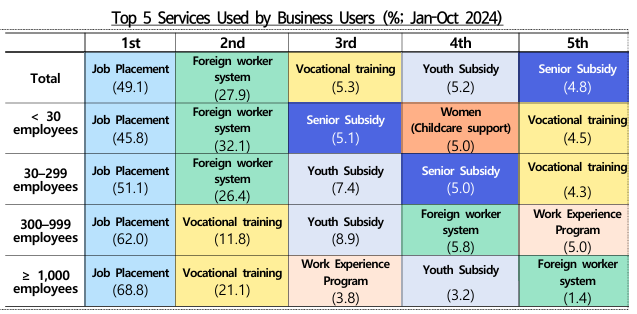
Among the 400,000 registered business members, 60.2% (240,000) used one or more of the 44 employment services between January and October 2024, with a total of 2.08 million service transactions. The most frequently used services were job placement (49.1%, 1.02 million cases) and the foreign workforce program, including foreign recruitment and placement services (27.9%, 580,000 cases), which together accounted for 77.1% of all usage. In 2024, 48.0% of business members used job placement (recruitment) services, followed by vocational competency development (5.3%), youth-related subsidies (5.2%, such as the Work-Study Employer Subsidy and Youth Employment Promotion Subsidy), senior employment subsidies (4.8%, such as the Senior Employment Support Subsidy), and women-related subsidies (4.1%, such as parental leave and substitute worker support). Across all company sizes, job placement was the most commonly used service. Companies with fewer than 30 employees and those with 30 299 employees made greater use of the foreign workforce program (32.1% and 26.4%, respectively) and senior employment subsidies (5.1% and 5.0%, respectively). Larger companies, with 300–999 employees and 1,000 or more employees, showed higher utilization of vocational competency development (11.8% and 21.1%, respectively), youth-related subsidies (8.9% and 3.2%, respectively), and work-experience programs (5.0% and 3.8%, respectively).